
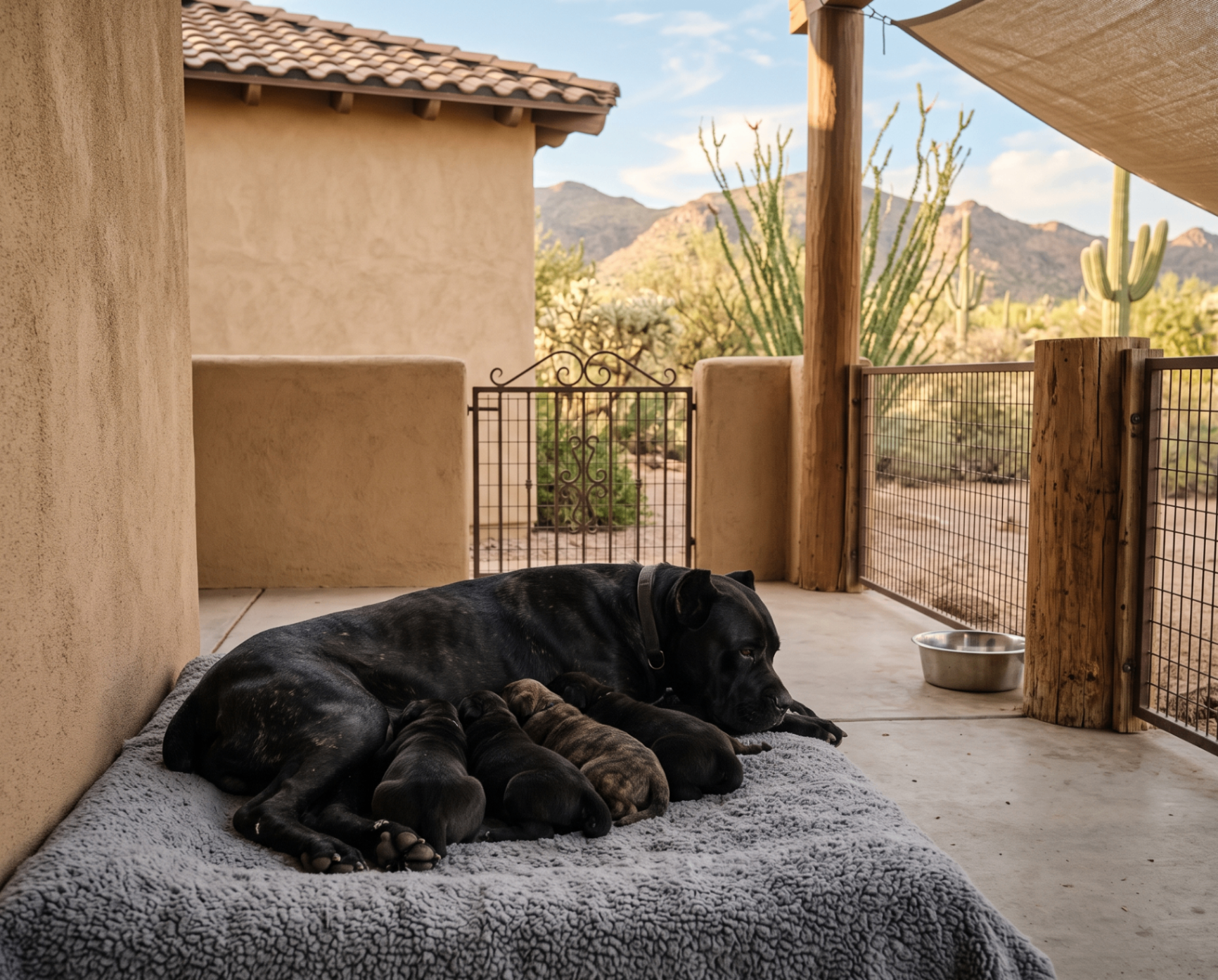
We get asked this constantly, usually by families who've read something alarming and want reassurance. We're not going to just reassure you, because the honest answer matters more.
A Cane Corso is a guardian breed with real protective instinct and the physical capacity to act on it. That is not the same thing as aggression, but it does mean this breed demands more from an owner than most.
What the breed was actually built to do
The Corso descends from Roman war dogs and spent centuries on Italian farms guarding property, managing livestock, and hunting large game. It was bred to assess a situation, decide whether something was a threat, and respond without waiting for instruction.
That independent judgment is the defining trait of the breed. It's why a well-raised Corso is such a remarkable family dog — and why a poorly raised one is genuinely dangerous. You cannot breed out the instinct. You can only shape how it gets expressed.
Normal guardian behavior versus actual aggression
Families often mistake healthy guardian behavior for aggression, and occasionally mistake real warning signs for normal protectiveness. The distinction matters.
- Normal: positioning between you and a stranger, alert watchfulness, a low warning bark at an unfamiliar car
- Normal: reserved, neutral behavior with strangers rather than friendly enthusiasm
- Normal: heightened alertness at territory boundaries — the gate, the front door
- Not normal: growling or snapping at family members, resource guarding against the household
- Not normal: reactivity toward every passing dog or person on a walk
- Not normal: escalating without warning, or an inability to settle after a trigger passes
What actually creates an aggressive Corso
In our experience, aggression in this breed almost always traces back to one of four things — and three of them are entirely preventable.
First, breeding. Temperament is substantially heritable. A breeder who pairs two anxious or sharp dogs produces puppies predisposed toward reactivity, no matter how they're raised. This is the single largest factor and the one you control only by choosing your breeder carefully.
Second, missed socialization. The window between three and sixteen weeks is when a puppy calibrates what's normal. A Corso that doesn't meet children, strangers, other dogs, and unfamiliar environments during that period grows into an adult that treats novelty as threat.
Third, inadequate leadership. This breed tests boundaries and fills any leadership vacuum it finds. Corsos don't need harshness — they need consistency. Inconsistent households produce dogs that make their own decisions about who's allowed near the family.
Fourth, under-stimulation. A hundred-pound working dog with nothing to do finds work. That work is rarely something you'd have chosen.
Are they safe around children?
A well-bred, well-socialized Corso raised alongside children is typically patient and remarkably tolerant with them. Ours grow up underfoot in a busy household and treat the kids as part of the pack to be watched over.
That said, we tell every family the same thing: this is a hundred-plus pound dog, and no dog of any breed should be unsupervised with young children. Not because of aggression — because a Corso rising to greet someone can knock a toddler flat without any intent at all. Physics is the more realistic concern than temperament.
Who shouldn't get this breed
We turn families away, and we'd rather do that than place a puppy badly. A Corso is a poor fit for a first-time dog owner, for a household that can't commit to structured training through the first two years, or for anyone drawn to the breed specifically because it looks intimidating.
That last one is the one we screen hardest for. People who want a Corso as a weapon get told no. The breed deserves better, and so does whoever ends up living next door.
What responsible breeding looks like in practice
We temperament test every puppy before placement and match dogs to homes rather than letting families pick on looks. A confident, pushy puppy goes to an experienced handler. A softer, more biddable one goes to the family with young kids.
We also stay reachable for the life of the dog. Most behavioral problems are fixable if they're caught at eight months instead of three years, and the families who call us early almost never end up in trouble.
Frequently asked
- Do Cane Corsos turn on their owners?
- No — that's a myth applied to most guardian breeds. Dogs don't spontaneously change character. What looks sudden is nearly always the endpoint of warning signs that went unrecognized, often for months.
- Are Cane Corsos banned anywhere?
- Some municipalities and many homeowners insurance carriers restrict the breed. Check your local ordinances and call your insurer before committing — this catches families out more often than any temperament issue.
- Can a Cane Corso be a good first dog?
- Honestly, rarely. The breed's independence and size are unforgiving of the mistakes every first-time owner makes. We generally recommend starting with experience under your belt.