
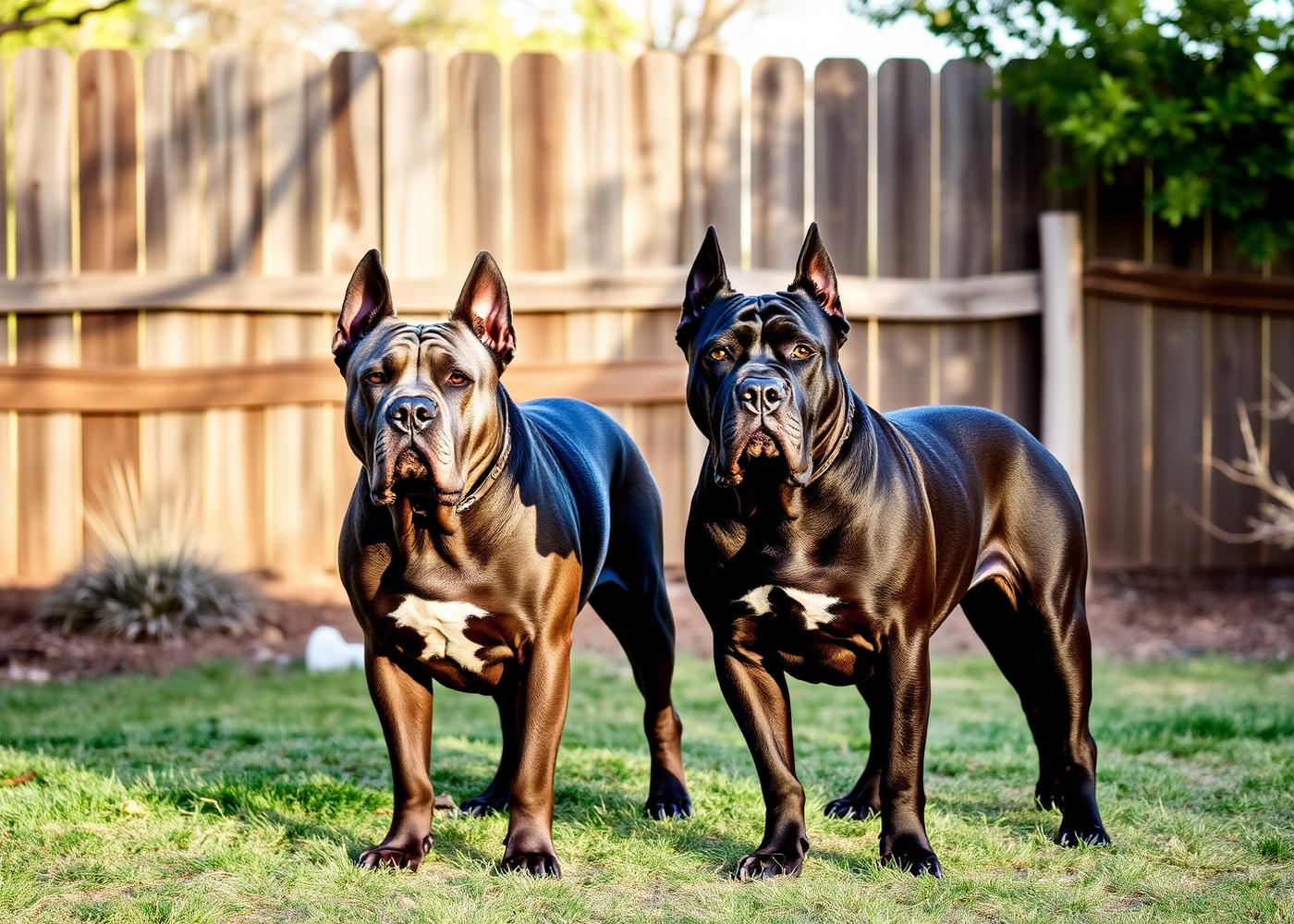
"How big will he get?" is the second question every family asks us, right after color. It matters more than color does — a Corso's adult size decides your vehicle, your fencing, your furniture, and how much leash training you need to have finished before the dog outweighs the person holding it.
Below is the growth pattern we actually see in our litters, along with the part most charts leave out: growing fast is not the same as growing well.
Adult Cane Corso size
A mature male Cane Corso stands 25 to 27.5 inches at the shoulder and weighs roughly 99 to 120 pounds in working condition. Females stand 23.5 to 26 inches and generally weigh 88 to 105 pounds.
Anything much beyond that range is usually either overweight or an oversized line bred for bulk rather than soundness. A 150-pound Corso is not a better Corso — extra mass puts real load on hips, elbows, and heart, and it tends to shorten the dog's working years.
Cane Corso puppy weight chart
These are typical ranges, not targets. Healthy puppies track a curve rather than a number, and littermates can differ by ten pounds at six months and finish identical.
- 8 weeks — 15 to 20 lbs
- 3 months — 30 to 40 lbs
- 4 months — 40 to 55 lbs
- 6 months — 60 to 80 lbs
- 9 months — 75 to 95 lbs
- 12 months — 85 to 105 lbs
- 18 months — near adult weight, still filling out through the chest
- 2 to 3 years — final muscle and head development complete
Males vs females
Males are taller, heavier, and blockier in the head, and they mature more slowly — a male can behave like an adolescent well past his second birthday. Females mature earlier, tend to be easier through the teenage months, and are often the better first Corso for a family new to the breed.
Neither is more affectionate. Both are velcro dogs that will lie on your feet while you cook dinner.
Why growing too fast is a problem
Large-breed puppies fed a rich, calorie-dense diet grow bone faster than the joint can support. That is one of the most common preventable contributors to hip and elbow problems in this breed, and it happens quietly — the puppy looks impressive right up until he doesn't.
We send every family home with a large-breed puppy feeding plan for that reason. You want to see a light hourglass shape from above and be able to feel ribs under a thin layer of muscle. A puppy you can't feel ribs on is being set up for a surgery bill.
Practical planning for a 100-pound dog
Buy the crate for the adult, not the puppy — a 48-inch crate with a divider covers the whole first year. Plan on six-foot fencing, a front-clip harness for adolescence, and a vehicle the dog can load into without you lifting him.
The single best investment is loose-leash walking before month six. Ninety pounds of untrained enthusiasm is a genuinely different animal from ninety pounds of trained enthusiasm.
Frequently asked
- When is a Cane Corso full grown?
- They reach close to full height by twelve months, adult weight around eighteen to twenty-four months, and finish filling out in chest and head between two and three years.
- How much should a 6-month-old Cane Corso weigh?
- Typically 60 to 80 pounds, with males at the top of the range. Body condition matters more than the scale — you should be able to feel ribs easily.
- Are there miniature or XL Cane Corsos?
- No. Both are marketing terms. Undersized dogs usually mean a mixed pedigree, and 'XL' lines are typically bred for bulk at the expense of joint health and lifespan.