
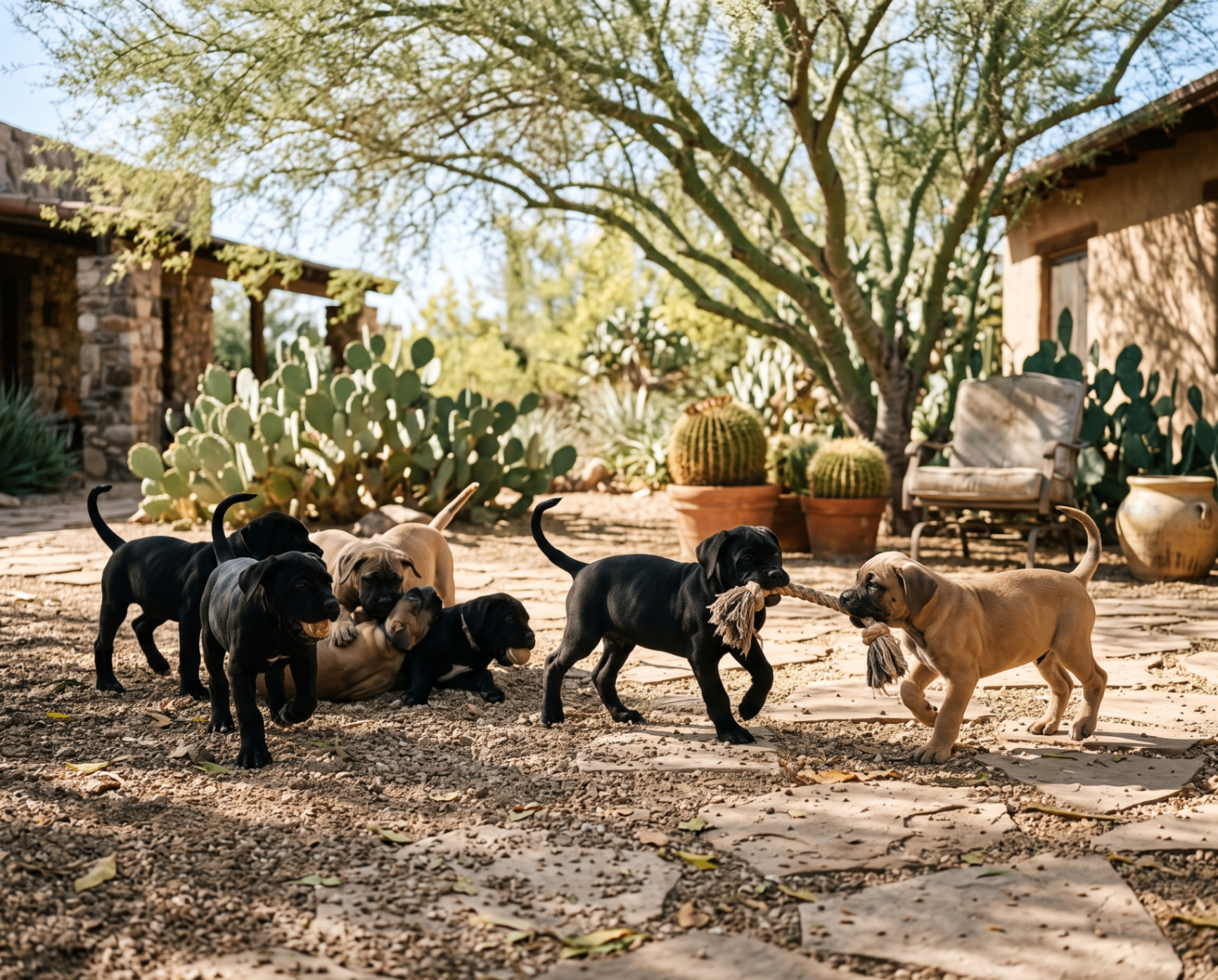
Training a Cane Corso is not like training a retriever. This is a dog bred to make independent decisions, and it will absolutely make them if you don't establish yourself as the one making them first.
The good news is that Corsos are highly intelligent and genuinely want to work with a person they trust. The work is front-loaded — get the first two years right and you'll have an easy dog for the following decade.
8 to 16 weeks: the window that closes
This is the most consequential period in the dog's entire life, and it is time-limited. During this window a puppy is forming its baseline model of what's normal and safe. Experiences that happen now become unremarkable forever; things missed now can become threats later.
The goal isn't obedience yet — it's exposure. Calm, positive, varied exposure to as much of the world as you can safely manage.
- Different people — men, women, children, hats, beards, uniforms, wheelchairs
- Surfaces — tile, gravel, grass, metal grates, wobbly footing
- Sounds — vacuums, traffic, doorbells, thunder recordings played at low volume
- Handling — ears, paws, mouth, tail, so veterinary visits stay easy at 110 lbs
- Crate training from day one, as a calm place rather than a punishment
- Car rides that don't always end at the vet
4 to 6 months: foundation obedience
Now you build the vocabulary. Keep sessions short — five to ten minutes, several times daily — and use food and praise generously. This breed shuts down under harsh correction and remembers unfairness for a long time.
Prioritize impulse control over tricks. A Corso that can wait at a threshold and disengage from a distraction is worth far more than one that can shake hands.
- Name recognition and reliable recall — start indoors, build slowly
- Sit, down, and place, with duration rather than just the initial response
- Leave it and drop it — genuinely important with a dog this powerful
- Loose-leash walking, established before the dog outweighs you
- Threshold manners — waiting at doors rather than bulldozing through
- Settle on cue, teaching the off switch this breed needs
6 to 18 months: adolescence, and the phase that surprises everyone
Somewhere around seven or eight months, the puppy that knew everything will appear to forget all of it. This is normal, it is temporary, and it is where most owners lose ground.
Your adolescent Corso is testing whether the rules are actually rules. Guardian breeds do this more assertively than most. What's needed is not escalation but absolute consistency — the same boundaries, enforced calmly, every single time. Households that get inconsistent here produce adults that negotiate everything.
This is also when protective instinct starts switching on. A dog that ignored strangers at five months may start alerting at ten. That's the breed arriving on schedule; your job is to teach it that you decide what warrants a response.
The commands a Corso genuinely needs
Beyond basic obedience, a few specific behaviors matter disproportionately in a guardian breed. These are the ones we tell every family to make bulletproof.
- A rock-solid recall — the single most important safety behavior you will ever teach
- Place or bed — sends the dog to a defined spot and holds it while guests arrive
- Enough or that'll do — ends alerting behavior and returns the decision to you
- Stationary greeting — no jumping; a 110 lb dog greeting enthusiastically injures people
- Muzzle conditioning — not because you expect problems, but because an emergency vet visit is a terrible time to introduce one
What doesn't work with this breed
Heavy-handed dominance methods backfire badly here. Alpha rolls, prolonged physical corrections, and confrontational techniques damage the trust a Corso needs to defer to you, and a dog this size that decides you're a threat is a genuine problem.
Equally ineffective is the opposite — permissiveness. A Corso with no structure doesn't become sweet and free-spirited; it becomes a dog making its own security decisions about your visitors. The target is calm, consistent, unambiguous leadership. Firm and fair, never harsh.
When to bring in a professional
We recommend a group puppy class early for the socialization value, followed by private work with someone experienced in guardian breeds. That last qualifier matters. A trainer whose experience is mostly labradors and doodles may not read a Corso accurately or anticipate the adolescent shift.
Ask a prospective trainer directly what they've worked with. Corsos, presas, boerboels, mastiffs — someone who's handled these dogs will tell you plainly. Get help at the first sign of a problem rather than after six months of it rehearsing.
Frequently asked
- Are Cane Corsos hard to train?
- They're intelligent and learn quickly, but they're independent and will test boundaries — which makes them demanding rather than difficult. Consistency matters far more than technique with this breed.
- When should Cane Corso training start?
- The day the puppy comes home at eight weeks. Socialization in particular is time-sensitive and cannot be made up later.
- Do Cane Corsos need protection training?
- Almost never. A well-bred Corso is naturally protective without any specialized work. Formal protection training on an already-capable guardian usually creates liability rather than safety for a family pet.